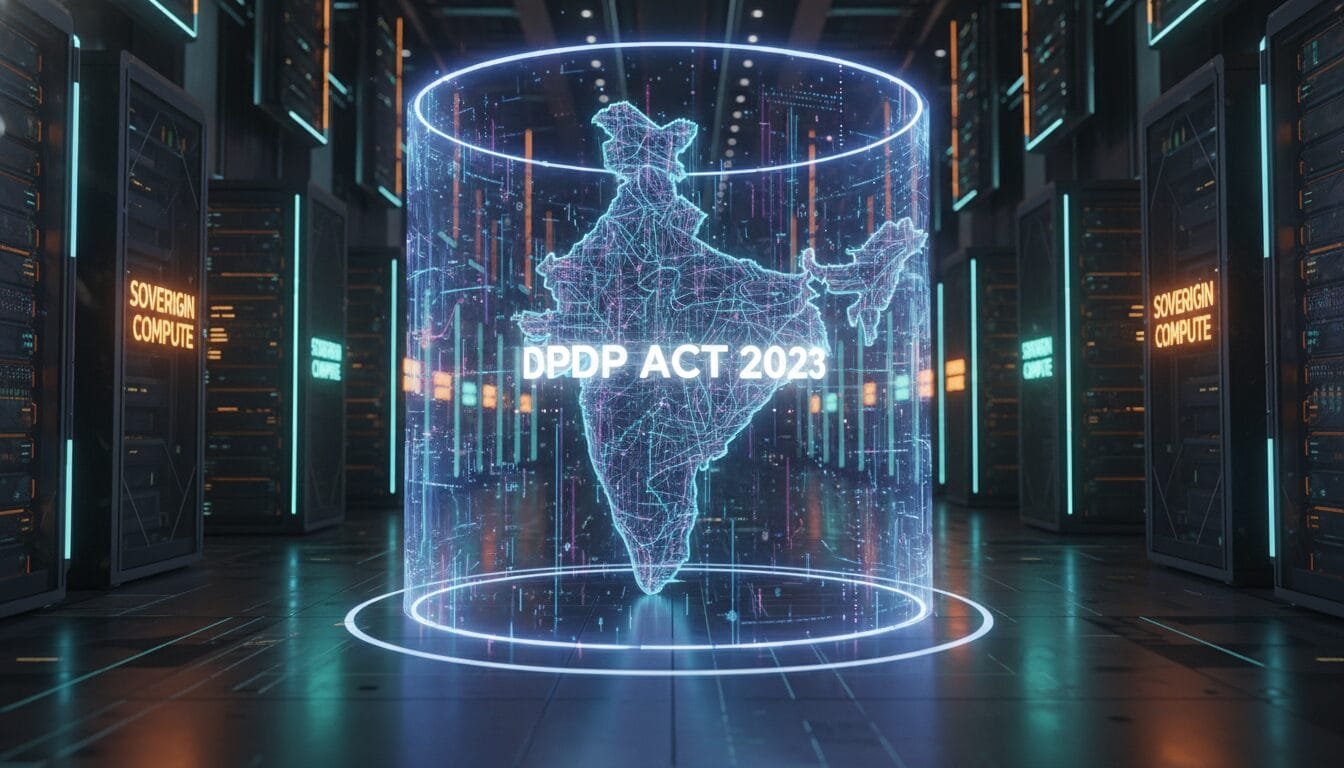




AI Safety is no longer about red-teaming model toxicity. It is about physical hardware custody. Software-level guardrails fail against structural vulnerabilities. Enterprise data fiduciaries now face a stark reality: off-premise computation fundamentally breaches digital sovereignty.
- The Bottom Line
- The Structural Shift: Silicon Reality vs. The Compliance Chasm
- Signal Check: Hype vs. Execution Reality
- Capital Stakes: Shadow Compute and the Hardware Arbitrage
- The Contrarian Thesis: The “Performed Sovereignty” Trap
- First-Principles Analysis: The Four Layers of Sovereignty
- Practical Implementation / Tactical Execution
- The Red-Team Assessment
The Bottom Line
India’s operationalized Digital Personal Data Protection (DPDP) Act has collided with the escalating costs of cloud-hosted Large Language Models (LLMs). This forces a massive enterprise repatriation cycle. Agentic AI workloads are abandoning centralized cloud APIs for local Neural Processing Units (NPUs). This defensive maneuver bypasses strict cross-border data transfer limitations and isolates the severe Data Fiduciary Liability detailed in Section 13. For Chief Information Security Officers, the NPU is not just a compute accelerator. It is a mandatory physical vault for autonomous processes, permanently altering the architectures for orchestrating the 2026 enterprise.
The Structural Shift: Silicon Reality vs. The Compliance Chasm
The legislative reality of 2026 exposes a severe execution gap. Recent EY data confirms that 71% of Indian enterprises struggle to interpret the DPDP Act, and only 38% of organizations have successfully categorized their personal data. Streaming sensitive, unstructured PII to a public cloud inference engine constitutes an unacceptable statutory risk.
Simultaneously, the physics and economics of cloud inference are breaking down. Public cloud GPU costs have surged since 2022. For continuous systems, the network latency of a 700ms cloud round-trip paralyzes real-time autonomous execution. Local hardware solves this through radical performance density. Workstations equipped with next-generation silicon—such as the discrete NPUs in the Dell Pro Max 16 Plus—can now run 120-billion parameter models locally. By utilizing advanced FP4 quantization instead of bloated FP16 precision, response times collapse to a near-instant 20-60ms.
More Read

Signal Check: Hype vs. Execution Reality
| Hype (Noise) | Technical Reality (Signal) | Economic Impact |
|---|---|---|
| “Sovereign Cloud” solves all DPDP compliance issues. | Data residency is not operational sovereignty. Foreign support staff retain infrastructure access. | Capital migrates to bare-metal and on-device NPUs to eliminate third-party processor liability. |
| Frontier LLMs (GPT-5/Claude 3.5) are mandatory for enterprise agents. | Quantized Small Language Models (SLMs) on local NPUs match frontier logic for narrow tasks. | Recurring API expenditure collapses. On-premise hardware payback periods shrink to 18-24 months. |
| State-backed compute solves the startup AI hardware deficit. | Centralized GPU clusters face massive utilization friction due to administrative leasing constraints. | Private enterprise diverts CapEx toward decentralized “Shadow Compute” local clusters. |
Capital Stakes: Shadow Compute and the Hardware Arbitrage
Capital reallocation reveals true market maturity. The IndiaAI Mission deployed 38,000 GPUs at Rs 65/hour to subsidize startup compute. Yet, institutional inertia and seven-day lease caps leave this massive public capacity vastly underutilized. Public cloud infrastructure lacks the agility required for continuous fine-tuning. Consequently, private demand for on-premise NPU infrastructure is compounding at an estimated 20% CAGR. Organizations are actively trading OpEx API dependencies for upfront CapEx silicon investments, locking down absolute IP control through a structural arbitrage.
The Contrarian Thesis: The “Performed Sovereignty” Trap
Hyperscalers building data centers in Mumbai or Pune do not solve the privacy equation. “Sovereignty-as-a-Service” is merely performed sovereignty. Renting model weights via API leaves inference vulnerable to foreign subpoenas and unauthorized access. Model inversion attacks routinely reconstruct PII from cloud-hosted weights. True AI safety requires air-gapped NPUs that establish a localized, offline trust-root.
First-Principles Analysis: The Four Layers of Sovereignty
Strategic authority requires evaluating sovereignty through a rigid four-layer framework:
- Data Sovereignty: Legal jurisdiction governing raw data ingestion.
- Model Sovereignty: Outright ownership of model weights, converting AI from a rented utility into a depreciable asset.
- Hardware Sovereignty: Physical custody of the silicon executing the tensor math.
- Operational Sovereignty: Cryptographic assurance that cross-border personnel cannot access the runtime environment.
Practical Implementation / Tactical Execution
Engineering teams are deploying this framework immediately. Indian wealthtech platform StockGro bypassed frontier cloud LLMs to launch a custom SLM utilizing over 5 billion parameters. They trained 80 distinct autonomous agents on proprietary financial conversational data. Executing these agents locally circumvents cloud hallucination rates entirely. Implementing robust models like Phi-3 Mini directly on edge NPUs ensures the reasoning engine operates strictly within user consent boundaries. This mathematically enforces DPDP data minimization rules.
More Read

The Red-Team Assessment
An adversarial audit of the NPU sovereignty doctrine reveals severe, unpriced failure modes:
- The Exemption Asymmetry: The DPDP Act grants extensive processing exemptions to state entities while strictly regulating private data fiduciaries. This two-tiered landscape centralizes state AI capability while restricting private-sector autonomous innovation.
- Supply Chain Bottlenecks: Inference may be local, but discrete enterprise NPUs rely on foreign fabrication pipelines. Hardware sovereignty remains an illusion if hardware replacement cycles are vulnerable to external geopolitical chokepoints.
- Thermal/Energy Degradation: Continuous multi-agent workflows push enterprise thermal management to the limit. Unoptimized models destroy battery life and degrade hardware rapidly, converting a compliance fix into a severe IT lifecycle liability.
The mandate is clear. Local silicon forms the new compliance perimeter. Organizations that fail to internalize their compute will become structurally unviable, outmaneuvered by competitors who own both their data and the physics of their reasoning.