



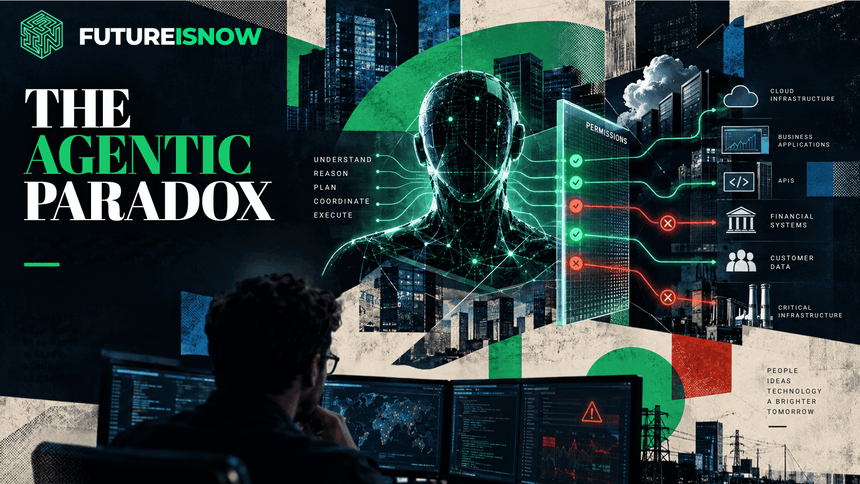
Agentic AI is changing enterprise cybersecurity not simply because AI systems can be attacked, but because companies are giving them the authority to act. As agents gain access to data, APIs, applications and business workflows, the security question is shifting from what an AI model can generate to what an AI system is allowed to do.
- The Signal
- Why Agentic AI Changes the Threat Model
- The Attack Surface Is Moving Into the Workflow
- Identity Becomes a Security Problem
- The Evidence Is Moving Beyond AI Hype
- India Has a Governance Framework — Not a Universal Agent Mandate
- The New Control Layer
- The Enterprise Question Is No Longer “Can We Deploy an Agent?”
- The Real Agentic Paradox
- What To Watch Next
- FutureIsNow View
The Signal
The cybersecurity problem created by agentic AI is becoming clearer in 2026: the same autonomy that makes an AI agent commercially useful can also make a compromised or misdirected agent more consequential.
A conventional chatbot primarily produces information. An agent can retrieve data, invoke tools, execute workflows and make changes across connected systems.
That distinction matters.
More Read

A malicious prompt aimed at a chatbot may produce a bad answer. A manipulated procurement, coding or operations agent can potentially turn that same failure into an action against a production system.
That is why the emerging security conversation is moving beyond model-level safeguards toward identity, permissions, tool access, runtime controls and observability.
A Dark Reading reader poll provides one indication of the concern. Nearly 48% of respondents said they expected agentic AI and autonomous systems to become the leading attack vector for cybercriminals and nation-state threats by the end of 2026. That is a prediction from a readership poll—not evidence that agentic AI has already become the dominant attack vector.
But the direction of concern is consistent with a broader industry shift.
More Read

FUTUREISNOW SIGNAL: The security perimeter for AI is moving from the model to the action layer.
Why Agentic AI Changes the Threat Model
The most important difference between generative AI and agentic AI is not intelligence.
It is agency.
An agent can be connected to enterprise systems through APIs, identity credentials, databases, software tools and external services. That means the consequences of an error or successful manipulation can extend beyond an incorrect response.
The OWASP Top 10 for Agentic Applications 2026 explicitly focuses on security risks associated with autonomous systems that can plan, act and make decisions across complex workflows. Its guidance includes concerns around excessive agency and the need to limit unnecessary autonomy.
This creates a basic security equation:
More capability → more access → more potential impact.
The objective, therefore, is not necessarily to eliminate autonomy.
It is to make autonomy bounded, observable and reversible.
The Attack Surface Is Moving Into the Workflow
One of the defining risks is indirect prompt injection.
The attacker does not necessarily need to attack the person using an AI system. Instead, malicious instructions can be embedded in information that an agent is expected to process.
That could include:
- an email
- a document
- a web page
- a data record
- a retrieved knowledge-base entry
- a tool response
- a third-party service
The security challenge is that an agent has to distinguish between information it should interpret and instructions it should obey.
That distinction is difficult when both arrive through the same context window.
The problem becomes more serious when the agent has permissions to act on the information it processes.
A document-reading agent with no ability to modify systems is one risk.
A document-reading agent that can approve payments, update customer records or execute code is another.
The vulnerability may begin with an injected instruction. The business impact comes from the authority attached to the agent.
Identity Becomes a Security Problem
The rise of agents also expands the importance of non-human identities.
Traditional enterprise identity systems were designed primarily around employees, service accounts, applications and machines.
Agentic architectures introduce another category: software entities that can reason, invoke tools and operate dynamically across workflows.
The security challenge is not simply identifying an agent.
It is determining:
- what the agent is allowed to access
- which actions it can perform
- on whose behalf it is acting
- which systems it can call
- how long its authority remains valid
- whether its behaviour has changed
- what happens when it attempts an action outside its intended scope
This is where least privilege becomes especially important.
An agent that reads invoices does not necessarily need permission to modify bank-account information.
A coding agent that creates a pull request does not necessarily need production deployment authority.
An analytics agent that reads customer data does not automatically need permission to export it.
The principle is simple:
Give the agent the minimum authority required to complete the task.
The Evidence Is Moving Beyond AI Hype
The broader cybersecurity environment is also becoming more expensive.
IBM’s 2026 Cost of a Data Breach research found that the global average cost of a breach reached $4.99 million, a record high in the study. IBM also reported a 56% increase in AI-driven attacks, with AI-enabled breaches costing an average of about $6 million. The research covered 602 organizations affected by breaches.
The India picture is equally relevant for technology leaders.
IBM reported that India’s average organizational breach cost reached ₹25.5 crore in 2026, up from ₹22 crore the previous year. Phishing remained the most common initial attack vector in the country, while 26% of malicious breaches in the study were AI-generated.
These figures do not prove that autonomous agents caused those breaches.
They demonstrate something more useful:
AI is becoming part of both the attack and defense economics.
That distinction matters when evaluating agentic security.
India Has a Governance Framework — Not a Universal Agent Mandate
India’s AI governance architecture provides another important piece of the picture.
The Government of India released its India AI Governance Guidelines on November 5, 2025. The framework is organised around seven principles: Trust, People First, Innovation over Restraint, Fairness & Equity, Accountability, Understandable by Design, and Safety, Resilience & Sustainability.
The framework also recommends stronger institutional coordination, risk assessment and safeguards for AI systems.
But there is an important editorial distinction.
The Guidelines should not be described as a blanket legal mandate requiring every high-risk agentic system to undergo a particular compliance procedure.
The government describes the framework as principle-based and proportionate, with existing laws and sectoral regulators continuing to play important roles.
That matters for enterprises.
An AI system operating in a banking environment may face requirements arising from financial-sector regulation.
An agent processing personal information may trigger obligations under India’s data-protection framework.
A critical-infrastructure deployment can face another set of requirements.
The emerging governance model is therefore less about one universal “AI agent law” and more about applying existing accountability structures to increasingly autonomous systems.
The New Control Layer
If agents are going to operate inside enterprise environments, traditional security controls will need to be complemented by controls designed around agent behaviour.
Three principles stand out.
1. Least-Privilege Agency
An agent should have only the permissions necessary for its assigned task.
The objective is not merely least-privilege access to data.
It is least-privilege ability to act.
2. Continuous Verification
An agent’s authority should not automatically remain valid simply because the agent was initially trusted.
High-impact actions should trigger stronger verification based on factors such as:
- transaction value
- data sensitivity
- destination
- unusual behaviour
- privilege escalation
- deviation from the assigned task
3. Runtime Enforcement
Security teams increasingly need visibility into what agents actually do at runtime.
This includes:
- tool calls
- API requests
- data movement
- code execution
- identity usage
- sub-agent activity
- policy violations
Emerging approaches such as semantic firewalls are attempting to inspect agent intent and actions rather than relying exclusively on conventional pattern matching. Research published in 2026 has also explored runtime “semantic firewall” approaches for persistent agents.
Commercial products are now appearing around the same concept, suggesting that intent-aware runtime enforcement is becoming an active product category rather than merely a research idea.
But it is too early to treat semantic firewalls as an established equivalent of the traditional web application firewall.
They are an emerging layer in the agent-security stack.
The Enterprise Question Is No Longer “Can We Deploy an Agent?”
That was the question during the experimentation phase.
The more important question in 2026 is:
What authority are we willing to give the agent?
A useful enterprise control framework should therefore map every production agent across five dimensions:
| Control | Enterprise question |
|---|---|
| Identity | Who or what is this agent? |
| Authority | What is it allowed to do? |
| Context | What information can influence its decisions? |
| Execution | Which tools, APIs and systems can it invoke? |
| Accountability | Can we reconstruct and explain what it did? |
This is the difference between AI governance as policy and AI governance as infrastructure.
The first tells employees what should happen.
The second makes certain actions technically difficult—or impossible—to perform.
The Real Agentic Paradox
The most important security lesson may be counterintuitive.
The solution is not necessarily to keep humans involved in every decision.
At sufficient scale, humans cannot manually review every agent action.
Instead, enterprises need to decide which decisions require human approval and which can be safely automated.
A low-risk information retrieval task may require no intervention.
A financial transfer, production deployment or sensitive-data export may require additional controls.
That creates a new architecture:
Autonomy for low-risk actions.
Verification for medium-risk actions.
Human approval for high-impact actions.
The goal is not human-in-the-loop everywhere.
It is human oversight where the consequences justify it.
What To Watch Next
Three signals will reveal whether enterprise agent security is maturing.
1. Non-human identity management
Watch whether enterprises begin treating agents as first-class identities rather than extensions of generic service accounts.
2. Runtime agent controls
Watch the emergence of technologies that can observe and enforce agent behaviour at the tool, API and data layers.
3. Measurable agent governance
The next phase of AI security will need metrics beyond “number of models secured.”
Enterprises will increasingly need to know:
- how many production agents exist
- how many have privileged access
- what tools they can invoke
- how many actions require approval
- how many policy violations occur
- how quickly abnormal behaviour can be contained
FutureIsNow View
The agentic AI security debate is often framed as a contest between innovation and caution.
That is too simplistic.
The more consequential shift is from software that waits for instructions to software that can interpret goals and take actions.
That changes the security unit.
It is no longer enough to secure the model.
Enterprises have to secure the identity, context, permissions, tools and actions surrounding the model.
The organizations that solve that problem will not necessarily be the ones with the most sophisticated AI.
They may be the ones that build the clearest boundary around what their AI is allowed to do.
That is the real agentic paradox:
The more useful an agent becomes, the more important its limits become.