



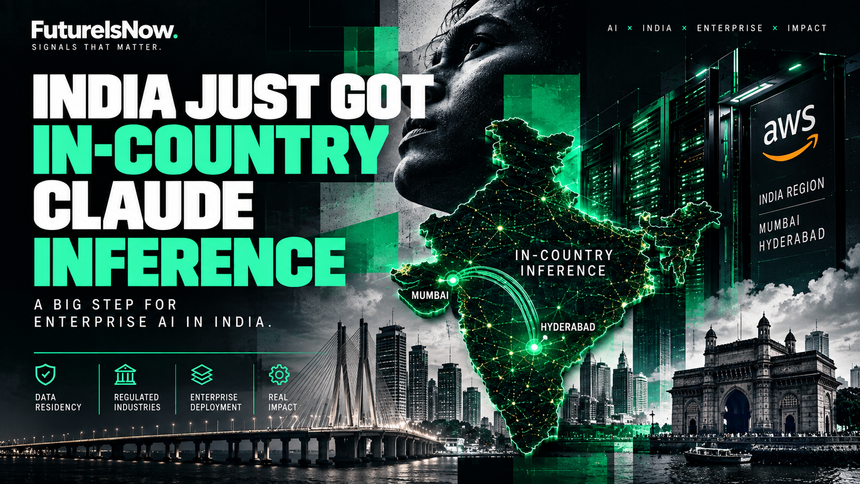
India’s enterprise AI market just crossed an important infrastructure milestone.
- The difficult part of enterprise AI is no longer getting access to a model
- What in-country inference actually changes
- What is Claude in-country inference in India?
- Which Claude models are available with in-country inference in India?
- Does in-country inference mean the data never leaves India?
- Does this automatically make an enterprise’s AI deployment compliant?
- Why is India important to Anthropic?
- Is Claude the only frontier AI model available for in-country inference in India?
- Why does in-country inference matter for Indian enterprises?
- What is the bigger trend?
Anthropic’s Claude models are now available with in-country inference in India through Amazon Bedrock, allowing requests made through the India endpoint to be processed within AWS infrastructure in the country. The offering includes Claude Opus 5, Claude Sonnet 5 and Claude Haiku 4.5. AWS says its India geographic inference profile routes requests between its Mumbai and Hyderabad regions, keeping the inference workload within India.
At first glance, this looks like another announcement about a leading AI model becoming available to Indian enterprises.
The bigger story is elsewhere.
More Read

India is becoming an important deployment geography for frontier AI.
That distinction matters.
The first wave of enterprise generative AI was largely about experimentation. Companies gave employees access to copilots, built internal chatbots, tested coding assistants and ran proofs of concept.
The next wave is considerably harder.

Companies want AI embedded inside banking systems, insurance workflows, software development environments, customer operations, healthcare platforms and internal enterprise applications. Once AI begins interacting with sensitive business information and operational systems, the requirements around security, governance and data location become much more significant.
That is where in-country inference changes the equation.
The difficult part of enterprise AI is no longer getting access to a model
India already has access to the world’s leading AI models.
The country has a large developer ecosystem, a rapidly expanding startup market and thousands of enterprises experimenting with generative AI. Anthropic itself describes India as one of Claude’s most important markets. According to data cited by Anthropic, India is its second-largest market for Claude.ai, while software development accounts for 45.2% of work-related tasks users bring to Claude in the country.
The challenge is moving from individual usage to enterprise deployment.
A developer experimenting with a coding assistant has a very different risk profile from a bank processing financial information through an AI system.
The same applies to an insurer handling claims, a healthcare company processing sensitive records or a government organisation working with citizen information.
Enterprise AI therefore has to satisfy requirements beyond model performance.
Data handling, security, governance, auditability, access controls and infrastructure location all become part of the deployment decision.
This is why AWS’s announcement is more important than another model availability update.
It addresses one of the practical barriers that has been standing between AI experimentation and production deployment.
What in-country inference actually changes
Amazon Bedrock’s India geographic inference capability allows requests to be routed between AWS’s Mumbai and Hyderabad regions while remaining within India’s geographic boundary.
AWS says prompts and model outputs can move between those two regions, but the inference request does not leave India. It also says cross-Region inference operates through AWS’s secure network with encryption in transit.
There is an important technical distinction here.
This is not necessarily the same thing as running a completely independent copy of a model inside a single Indian data centre.
Instead, AWS is using its geographic cross-Region infrastructure to provide access to a broader pool of compute while restricting the inference geography to India.
That gives enterprises a combination of local processing and regional capacity.
For organisations concerned about where sensitive AI workloads are processed, that can be a meaningful difference.
It also demonstrates how cloud infrastructure is adapting to the requirements of enterprise AI.
The model itself may have been developed by a company headquartered outside India. The enterprise application may also be global. But the actual inference workload can increasingly be processed within the geography where the customer operates.
That is the infrastructure development worth watching.
Data residency is becoming an AI deployment consideration
Data residency has traditionally been discussed in the context of databases, cloud storage and regulated information.
Generative AI introduces another dimension.
When an enterprise sends information to an AI model, the location and handling of that processing become relevant to the organisation’s overall risk and compliance framework.
In-country inference does not automatically make an AI application compliant with every Indian regulation. Enterprises still have to determine what information can be sent to a model, how it is governed, who can access it and what controls apply to the application.
But the ability to keep inference within a defined geography removes one important obstacle.
That is particularly relevant for regulated sectors.
AWS explicitly positions the India capability for organisations with local data-processing requirements, including financial services, healthcare and the public sector.
The importance of that market is difficult to overstate.
India’s largest financial institutions are among the country’s biggest potential users of enterprise AI. Banks and insurers have enormous volumes of documents, customer interactions, operational data and internal knowledge that can potentially be augmented by AI.
The opportunity is substantial, but so is the governance burden.
Infrastructure that allows enterprises to keep AI processing within India makes the conversation considerably easier to have with security, technology and compliance teams.
This is also a signal about where the AI market is heading
Claude is not the only frontier model being positioned for in-country inference in India.
Amazon Bedrock introduced India geographic cross-Region inference for OpenAI models in August 2026. AWS said the capability was intended to support organisations with local data-processing requirements, including businesses in financial services, healthcare and the public sector.
That is an important market signal.
The direction of travel is not simply toward more AI models.
It is toward more deployment options for those models.
Global AI companies increasingly need to work within the infrastructure, regulatory and operational requirements of individual markets.
India is becoming important enough to warrant that treatment.
This also changes the way the country’s AI opportunity should be viewed.
India does not necessarily need to build every frontier model itself to become strategically important in AI.
It can create value through the infrastructure, talent, applications, enterprise integration and governance systems surrounding those models.
That is a different form of technological leverage.
India’s AI infrastructure market is expanding at the same time
The Claude announcement arrives as India’s broader AI infrastructure ecosystem is expanding.
Indian enterprises are increasing investment in AI infrastructure, while data-centre capacity, cloud infrastructure and specialised AI computing are attracting significant capital.
A recent report citing IBM India said Indian enterprises had increased AI infrastructure investment by 58%. The same report highlighted governance as a significant barrier to scaling AI, with 68% of organisations identifying governance gaps as an obstacle.
That combination is revealing.
Enterprises are spending more money on the physical and technical infrastructure required for AI, but they are simultaneously discovering that infrastructure alone does not solve the deployment problem.
AI needs governance around it.
It needs security.
It needs access controls.
It needs monitoring.
It needs clear policies about how data enters and leaves AI systems.
And as enterprises move toward autonomous agents, those controls become even more important.
The agentic AI transition raises the stakes
The move from generative AI assistants to AI agents changes the infrastructure conversation.
A chatbot might answer a question based on information provided to it.
An enterprise agent can potentially retrieve information from internal systems, interact with applications, initiate workflows and take actions on behalf of employees.
That makes the connection between the AI model and enterprise infrastructure much deeper.
For a financial institution, an AI system might eventually interact with customer-service platforms, financial systems, internal knowledge bases and compliance tools.
For a technology company, it could interact with software repositories, development environments and production systems.
For a GCC, it could become part of global engineering, finance, analytics or customer operations.
At that point, AI is no longer simply an application employees use.
It becomes part of the company’s operating infrastructure.
That makes deployment architecture a strategic issue rather than an IT implementation detail.
India’s GCC story makes this even more significant
The development also fits into the larger transformation of India’s Global Capability Centre ecosystem.
India’s GCCs have historically been associated with technology delivery, engineering talent and cost efficiency.
That model is evolving.
The more advanced centres increasingly own product engineering, artificial intelligence, data platforms, cybersecurity, enterprise architecture and global technology operations.
That creates a much more demanding AI environment.
A GCC responsible for building an AI platform for a global enterprise does not simply need access to a powerful model. It needs to build an environment that can satisfy the security and governance requirements of the parent organisation.
This is one reason India’s AI infrastructure story and GCC story are increasingly connected.
The country is not just supplying engineers who use AI tools.
It is increasingly becoming a location where global enterprises build and operate AI-enabled technology systems.
In-country inference strengthens that proposition.
The meaning of AI sovereignty is changing
The phrase “sovereign AI” is often used to describe domestic AI models, local compute or government-backed infrastructure.
But sovereignty does not necessarily require a country to own every component of the technology stack.
There is another form of sovereignty that is becoming commercially important: the ability to control where AI workloads are processed and how those workloads interact with sensitive data and enterprise systems.
India’s in-country inference capabilities strengthen that position.
Global frontier models can still be used.
Indian cloud infrastructure can still provide the underlying capacity.
Indian enterprises can still retain control over their applications and data environments.
That creates a pragmatic model of AI sovereignty: control over deployment without necessarily requiring ownership of every underlying model.
For businesses, that distinction matters because enterprises ultimately care less about where a model was created than whether they can deploy it securely, reliably and within their operating requirements.
The real competition is moving beyond model performance
The first stage of generative AI was dominated by model competition.
Companies compared reasoning capabilities, context windows, coding performance, benchmarks and multimodal abilities.
Those comparisons will continue.
But enterprise adoption introduces another competitive dimension.
A model that is extremely capable but difficult to deploy inside a customer’s required security and regulatory environment will face a different commercial challenge from a model that can be integrated into that environment more easily.
That is why infrastructure partnerships are becoming strategically important for AI companies.
The winners in enterprise AI will not simply have strong models.
They will have strong models plus the infrastructure, integrations, governance capabilities and distribution required to put those models into production.
India is becoming an important market in that competition.
What this means for India’s AI position
The Claude announcement should therefore not be read simply as Anthropic expanding access to another major market.
It is evidence of something broader.
India is becoming a serious destination for frontier AI deployment.
The country has the enterprise demand.
It has the technical talent.
It has a rapidly expanding cloud and data-centre ecosystem.
It has a large GCC footprint.
It has financial institutions and large enterprises looking for ways to operationalise AI.
And now, increasingly, it has infrastructure that allows some of the world’s most advanced AI models to be processed within the country.
That combination creates an important opportunity.
India’s AI advantage is gradually moving beyond talent and cost.
It is becoming about the ability to build, integrate and operate AI at scale.
That is a much more valuable position in the global technology economy.
FutureIsNow Signal
The most important part of Anthropic’s India announcement is not that Claude can now be accessed locally.
It is that the requirements of the Indian enterprise market are beginning to influence how frontier AI is deployed.
That is a meaningful shift.
For years, the question was whether Indian companies would adopt global AI platforms.
The more important question now is how those platforms will be engineered to work inside India’s enterprise and regulatory environment.
In-country inference is one answer.
It will not solve every challenge around enterprise AI. It does not eliminate the need for governance, security or responsible data practices.
But it removes one significant infrastructure constraint.
And as AI moves deeper into financial services, healthcare, government, GCCs and large enterprises, that constraint matters.
India is moving from being a major consumer of global technology to becoming a major deployment environment for global AI.
That is the signal.
Frequently Asked Questions
What is Claude in-country inference in India?
Claude in-country inference means that requests sent to Claude through the India geographic inference profile on Amazon Bedrock are processed within AWS infrastructure in India. AWS says the India profile can route requests between its Mumbai and Hyderabad regions while keeping the inference within the country.
Which Claude models are available with in-country inference in India?
AWS announced availability of Claude Opus 5, Claude Sonnet 5 and Claude Haiku 4.5 through Amazon Bedrock’s India geographic cross-Region inference capability.
Does in-country inference mean the data never leaves India?
For the India geographic inference profile, AWS says requests are routed only between its Mumbai and Hyderabad regions. Prompts and outputs may move between those two Indian regions, but the inference remains within India.
Does this automatically make an enterprise’s AI deployment compliant?
No. In-country inference addresses the location of inference, but organisations still need their own security, privacy, governance, access-control and regulatory processes. Data residency is only one part of enterprise AI compliance.
Why is India important to Anthropic?
India is one of Claude’s most important markets. Anthropic data cited in Indian media shows that India is its second-largest Claude.ai market, with software development representing 45.2% of work-related tasks users bring to Claude in the country.
Is Claude the only frontier AI model available for in-country inference in India?
No. Amazon Bedrock also announced India geographic cross-Region inference for OpenAI models in August 2026, indicating that local AI processing is becoming a broader enterprise infrastructure requirement rather than a capability specific to one model provider.
Why does in-country inference matter for Indian enterprises?
It can make it easier for organisations with data-location requirements to consider frontier AI for sensitive workloads. This is particularly relevant to sectors such as financial services, healthcare and the public sector, where data handling and governance can influence whether an AI system is suitable for production deployment.
What is the bigger trend?
The bigger trend is the transition from AI experimentation to governed enterprise deployment. As companies move AI into production systems and increasingly adopt AI agents, infrastructure, security, governance and data controls become as important to deployment as the underlying model.