



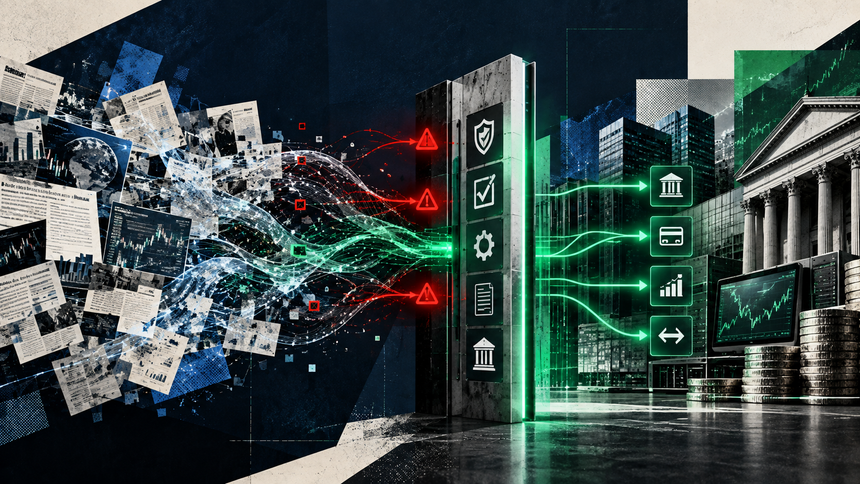
As AI moves from generating financial analysis to executing workflows, a familiar problemhallucination—takes on a different significance. The question is no longer simply whether an AI system can produce a wrong answer. It is whether an incorrect interpretation can cross a control boundary and become a financial action.
The Signal: When an AI Error Becomes an Action
Imagine a treasury agent instructed to monitor liquidity, interpret regulatory requirements and recommend—or eventually initiate—portfolio actions.
It encounters an unusual market signal.
It retrieves a regulatory document.
More Read

It interprets the text incorrectly.
The problem is not merely that the model has hallucinated.
The problem begins when the hallucinated interpretation is allowed to influence an irreversible financial action without an independent validation layer.
That distinction is becoming more important as financial institutions experiment with increasingly autonomous AI.
More Read

The Bank of England’s July 2026 Financial Stability Report says trading firms are using more autonomous AI systems, primarily for research, coding support, surveillance and other lower-risk operational tasks rather than fully autonomous trading. But it also highlights the difficulty of anticipating AI outputs and validating and bounding more autonomous systems as market conditions change.
The IMF makes the problem more explicit in its 2026 work on agentic payments: LLM-based agents are inherently nondeterministic, hallucinations remain a risk in payment, compliance and settlement contexts, and autonomous financial actions can create additional risks if agents are manipulated or misdirected.
The financial AI problem is therefore moving from output accuracy to action integrity.
Why Hallucination Matters More in Finance
An incorrect answer from a general-purpose chatbot may waste a few minutes.
An incorrect interpretation inside a financial workflow can potentially affect:
- a payment
- a credit decision
- a compliance review
- a liquidity calculation
- a portfolio recommendation
- a transaction-monitoring alert
- a regulatory report
- a settlement instruction
The underlying model may be identical.
What changes is what the model is connected to.
This is the central distinction between AI assistance and AI agency.
A model producing a recommendation remains one step removed from the consequence.
An agent connected to financial systems can become part of the decision and execution chain.
That is why the relevant question for a financial institution is no longer simply:
How accurate is the model?
It becomes:
What happens when the model is wrong?
The Financial Sector Is Already Confronting the Problem
The concern is not theoretical.
The Financial Stability Board’s June 2026 consultation on responsible AI adoption says financial institutions are using AI to transform operations and services, while also warning that rapid adoption can introduce or amplify risks that need to be identified and managed. Its proposed sound practices cover governance across the AI lifecycle.
The FSB’s August 2026 warning goes further, identifying the potential impact of frontier AI on cyber risk as an immediate concern for the financial system and calling for stronger resilience and recovery capabilities.
And the evidence is not limited to regulators.
A 2026 working paper from Amundi examining agentic AI in financial applications identifies hallucination and reproducibility among the main constraints on autonomy, concluding that human-in-the-loop verification remains necessary in current financial deployments.
The direction is therefore clear:
Financial institutions are exploring more autonomous AI, but the governance problem grows as the system moves closer to execution.
The Bigger Shift: From Answers to Authority
Traditional enterprise AI generally sits downstream of human judgment.
A financial analyst asks a model to:
- summarise a report
- extract information
- compare companies
- identify anomalies
- generate a draft
The analyst remains responsible for interpreting the result.
Agentic systems change the architecture.
An agent can potentially:
- interpret an objective
- retrieve information
- reason over that information
- invoke tools
- execute a workflow
- observe the result
- take another action
That creates a new failure mode.
An error can propagate.
A wrong interpretation can become a wrong calculation.
A wrong calculation can become a wrong recommendation.
A wrong recommendation can become an automated action.
The most important security boundary therefore sits between reasoning and execution.
The Architecture Needs Two Different Kinds of Intelligence
This is where neuro-symbolic architecture becomes interesting.
It should not be treated as a magic replacement for LLMs.
Its more useful role is architectural.
The neural layer can handle the parts of enterprise work that benefit from probabilistic interpretation:
- natural language
- unstructured documents
- ambiguous requests
- semantic classification
- information extraction
- contextual understanding
A deterministic layer can then handle operations where the rules are explicit:
- calculations
- eligibility checks
- limits
- policy enforcement
- regulatory constraints
- authorization
- transaction validation
The architecture becomes:
Probabilistic interpretation → structured representation → deterministic validation → controlled execution
That is a considerably stronger proposition than simply asking a larger model to become more confident.
FutureIsNow View
The debate around hallucinations often starts in the wrong place.
The question is not:
“Can we eliminate hallucinations?”
For probabilistic systems, that is unlikely to be the most useful engineering objective.
The better question is:
“Can we prevent an uncertain AI interpretation from becoming an unverified high-impact action?”
That changes the architecture.
The model can remain probabilistic.
The financial system around it does not have to be.
The future of enterprise AI may therefore be less about making models perfectly deterministic and more about building deterministic cages around the places where uncertainty becomes expensive.
That is where neuro-symbolic systems, policy engines, validation layers, knowledge graphs and human approval mechanisms become strategically important.
The winning architecture may not be:
AI that never makes mistakes.
It may be:
AI whose mistakes cannot easily become irreversible decisions.
What To Watch
1. Agentic payments
Watch how financial institutions define permissions, limits and authorization for AI agents that can initiate transactions.
2. Runtime governance
Watch for systems that can monitor an agent’s actions rather than simply evaluate its final answer.
3. Regulatory intelligence
Watch the emergence of systems that translate regulatory requirements into machine-testable policies.
4. Verification infrastructure
The next AI infrastructure layer may sit between the model and the enterprise system: validating what the model proposes before anything consequential happens.
5. The human checkpoint
The important question will not be whether enterprises keep humans in the loop.
It will be where they place the human boundary—and what happens when the human says no.