



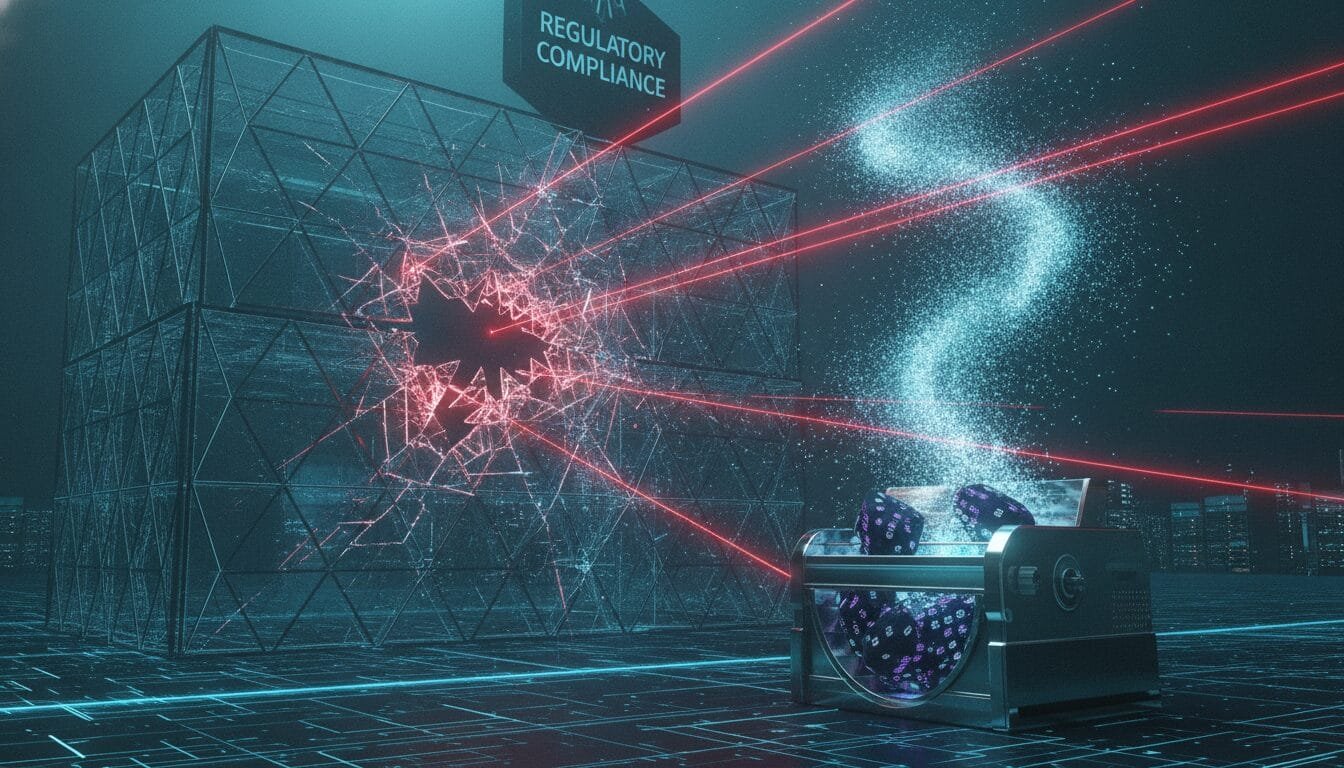
The Signal: From Asset to Toxic Liability
For the better part of a decade, the enterprise mandate was simple: store everything. The “Data Lakehouse” was sold as the ultimate repository for institutional intelligence—a centralized, low-cost architectural marvel that promised to fuel the generative AI revolution. However, by mid-2026, the physics of this strategy have inverted. What was once viewed as a strategic asset has devolved into Toxic Data Debt.
- The Signal: From Asset to Toxic Liability
- The Structural Shift: The End of “Store-First, Ask-Later”
- The Contrarian Thesis: Why “Total Data Governance” is a Value Trap
- Ground Truth: The India Stack Context
- Signal Check: Hype vs. Execution Reality
- First-Principles Analysis: The Physics of Data Decay
- The Path Forward: Strategic Decision Grid
- The “So What” for the Future: The Era of the Ephemeral P&L
The structural reality of 2026 is that data has a shelf life, and its preservation beyond that point creates a non-linear increase in legal and financial risk. In an era where Neural Weights vs. Statutory Rights governs the boardroom, the cost of storing a petabyte of unindexed, “just-in-case” data is no longer measured in AWS S3 credits; it is measured in regulatory exposure and AI Underwriting Risks. We are witnessing the first major cycle of “De-Datafication,” where the most sophisticated enterprises are aggressively purging legacy repositories to insulate themselves from the escalating enforcement of global privacy frameworks.
The Structural Shift: The End of “Store-First, Ask-Later”
The 2024 lakehouse architecture relied on the premise of “schema-on-read,” which allowed organizations to dump raw, unstructured data into cheap storage. In 2026, this lack of structural granularity has become a fatal flaw. Under the maturing India DPDP Act and the EU AI Act, the burden of proof has shifted. It is no longer enough to protect data; you must prove the provenance and the specific consent trail for every token used to train a model or inform an agent.
The economic math has changed:
More Read

- Audit Latency: In 2024, responding to a Data Subject Access Request (DSAR) took an average of 10-15 days. By 2026, automated regulatory “pings” require sub-48-hour compliance.
- The Inference Tax: Running Indian Vertical SaaS and SLMs on “dirty” data—data with mixed consent or expired retention—results in “Inference Pollution,” where the output of an AI can inadvertently leak PII, triggering catastrophic Algorithmic Collusion or privacy violations.
- Cyber-Insurance Recalibration: Premiums are now tied to “Data Hygiene Scores.” Companies with “dark data” (unclassified data exceeding 24 months) are seeing premiums rise by over 10% annually as the average cost of a breach hovers near $4.88 million.
The Contrarian Thesis: Why “Total Data Governance” is a Value Trap
The prevailing consensus suggests that the solution to data debt is more governance software. This is a fallacy. Most governance platforms are thin wrappers that add computational overhead without reducing the underlying liability.
The contrarian reality is that The most secure data is the data you no longer possess.
The Strategist’s priority in 2026 is not “Better Governance”; it is Aggressive Erasure. Enterprises are realizing that 80% of their lakehouse content provides 0% marginal utility for modern Revenue Per Agent metrics but accounts for 90% of the legal attack surface. The move is away from “Massive Data Lakes” toward “High-Intent Feature Stores.” If the data cannot be transformed into an actionable feature for a Copilot implementation within 90 days, its retention value is negative.
Ground Truth: The India Stack Context
In 2026, India has become the world’s most aggressive laboratory for data sovereignty. The RBI Bhashini Mandate and the full activation of the DPDP’s “Consent Manager” framework mean that the “Lakehouse” model is structurally incompatible with the Sovereign Stack.
More Read

| Factor | Global Context | India Reality (2026) |
|---|---|---|
| Regulatory Trigger | GDPR / EU AI Act (Risk-based) | DPDP Enforcement (Penalty-based: up to ₹250 Cr) |
| Consent Architecture | Implicit/Cookie-based legacy | Strictly Explicit via specialized Consent Managers |
| Data Localization | Soft requirements (industry-specific) | Hard local storage mandates for “Critical Data” |
| AI Nuance | Focus on bias and copyright | Focus on vernacular accuracy and local model bias |
For a CXO in India, the “Lakehouse” is a liability because it often sits in cross-border clouds (AWS Mumbai vs. Singapore). In 2026, the Information Gain is realizing that your 2024 cloud configuration is likely in violation of the current statutory rights regarding data mirroring and local processing.
Signal Check: Hype vs. Execution Reality
Understanding where the market is lying to itself is critical for capital allocation.
| Theme | Industry Hype (The Noise) | Execution Reality (The Signal) |
|---|---|---|
| Data Volume | “Data is the new oil; more is better.” | Data is “Nuclear Waste”; storage is cheap, but cleanup is lethal. |
| Lakehouse AI | “Your lakehouse is the foundation for your LLM.” | Legacy lakehouse data is too “noisy” for LLMs; 70% needs scrubbing. |
| Governance Tools | “Automated tagging will solve your compliance.” | LLM-based tagging is hallucinatory and creates a “Compliance Illusion.” |
| Cost Savings | “Cloud storage prices are falling.” | “Regulatory egress” and “Audit compute” costs are skyrocketing. |
First-Principles Analysis: The Physics of Data Decay
Why is the 2024 Lakehouse failing? It violates the first principle of Systemic Entropy.
When you store data, you are essentially “freezing” a moment of consent and context. However, the legal environment is “liquid”—it changes every quarter. The mismatch between “Frozen Data” and “Liquid Laws” creates Toxic Debt.
From a technical standpoint, the GPU Devaluation has further complicated this. We now have the compute power to scan petabytes for PII in minutes, but so do regulators. The asymmetric advantage of “hiding” data in a massive lake has vanished. If a regulator uses an agent to query your public-facing API and finds traces of leaked training data from 2024, the “Lakehouse” becomes the primary evidence of negligence.
The Path Forward: Strategic Decision Grid
For the CXO navigating 2026, the following matrix defines the transition from “Data Hoarding” to “Data Excellence.”
| Scenario | Actionable Strategy (The Play) | Avoid (The Trap) |
|---|---|---|
| Legacy Data (>3 yrs) | Hard Purge: Delete everything not required by tax/statutory law. | Moving legacy data to “Cold Storage” (The risk remains). |
| AI Training Sets | Synthetic Augmentation: Use SLMs to generate synthetic versions; delete raw PII. | Fine-tuning on “Raw Lake” data without re-consenting. |
| Cloud Strategy | Sovereign Silos: Localize processing for Indian/EU users strictly. | “Global Mesh” architectures that blur jurisdictional lines. |
| Vendor Management | Zero-Retention APIs: Demand vendors process data without storage. | Multi-year “Data Sharing” agreements with SaaS providers. |
The “So What” for the Future: The Era of the Ephemeral P&L
By 2030, the most successful enterprises will operate on Zero-Persistence Architectures. The goal will not be to “own” data but to “process” it in real-time and discard the liability immediately.
The Evolution of Credit Infrastructure in India already shows this: the most efficient lenders are moving toward “Data-on-Tap” via the Account Aggregator framework rather than building massive internal warehouses.
For the Strategist, the mandate is clear:
1. Audit the Lakehouse today for “Consent Drift.”
2. Institutionalize the “Right to Erasure” as an automated architectural feature, not a manual ticket.
3. Shift capital allocation from “Storage Expansion” to “Governance Orchestration.”
The 2024 Data Lakehouse was a monument to the “More is More” era. In 2026, that monument has become a tombstone for companies that fail to recognize the structural shift from data as an asset to data as a toxic legal debt. Information gain in this cycle isn’t about what you know—it’s about what you are brave enough to delete.