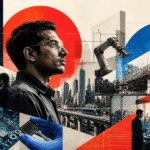




Starting a business once meant assembling a team, raising capital, outsourcing work or spending months building before reaching the market. In 2026, that equation is changing.
- From headcount to leverage
- The data is more cautious than the hype
- Why this shift is happening now
- AI models are becoming more useful for work
- AI is moving from chat to action
- Digital production is getting cheaper
- What a one-person company really looks like
- India’s emerging AI-native founders
- The AI-enabled operating stack
- The Base44 lesson
- The advantage is not AI access
- Orchestration is the new skill
- Where the model can fail
- A practical place to start
- FutureIsNow View
A growing number of founders, consultants, creators and independent professionals are using AI to research markets, build prototypes, create content, automate operations and serve customers with far less overhead than was possible only a few years ago.
The result is the rise of the one-person company: not a founder doing every task alone, but one operator directing an AI-enabled system.
This is not a promise of instant wealth. AI does not eliminate the need for customers, trust, sales, product-market fit or sound business judgment. But it does give individuals more leverage. A person with a laptop, industry knowledge and a clear offer can now test and run a business that may once have required several employees or an external agency.
More Read

The U.S. already has a huge base of businesses operating without paid employees. The Census Bureau counted 30.4 million nonemployer businesses in 2023, generating about $1.75 trillion in receipts. But nonemployer businesses are not the same thing as AI-native one-person companies. They are a much broader category.
AI is now becoming another layer on top of that existing business structure.
The question is whether that layer is powerful enough to materially change the economics of running a business with one person at the centre.
From headcount to leverage
For much of modern business history, scale depended on labour.
More Read

If a company wanted to sell more, support more customers, create more content or build more products, it needed more people. More people meant hiring, salaries, managers, departments, meetings and coordination.
The biggest organisations often had an advantage not just because they had better ideas, but because they could afford more capacity.
AI is beginning to change that.
A solo operator can now use AI to support functions that previously required specialists:
- Market research and competitor analysis
- Content writing and social-media planning
- Sales outreach and follow-up
- Landing-page and website creation
- Design concepts and campaign visuals
- Software prototyping and no-code product development
- Customer-support triage
- CRM updates, invoicing and reporting
- Video editing and content repurposing
The founder is still responsible for the business. But AI can handle a meaningful share of the repetitive work that often slows down early-stage growth.
The shift is from hiring people for every additional task to building smarter systems that help a smaller team—or even one person—do more.
The data is more cautious than the hype
There is an important reality check.
AI adoption is increasing, but it is not yet universal.
The U.S. Census Bureau’s Business Trends and Outlook Survey found that overall business AI use remained around 17% to 20% between December 2025 and May 2026. Among firms with four or fewer employees, the adoption rate remained below 20%.
That finding changes the story.
The one-person AI company should not be presented as the new normal.
It is better understood as an emerging operating model sitting inside a much larger universe of small and nonemployer businesses.
The Census Bureau’s research also found that AI use varies significantly by firm size and business function. The smallest companies are not automatically becoming the most AI-native companies simply because the tools are available to them.
That makes the competitive question more interesting.
The issue is no longer whether AI exists. It is whether a business can turn AI capability into measurable economic value.
Why this shift is happening now
The one-person company model is becoming more practical because three changes are happening at the same time.
AI models are becoming more useful for work
Modern AI models can do much more than answer basic questions or draft short emails. They can summarise long documents, analyse customer feedback, organise research, write code, create sales copy, develop workflows and generate first drafts for a wide range of business tasks.
For many entrepreneurs, this means they can start with a prototype instead of waiting for a full team.
A founder can use AI to study a market, create a landing page, prepare outreach messages, build an initial product or service workflow, and test customer demand in days or weeks rather than months.
AI is moving from chat to action
The next stage of AI is not just conversation. It is action.
AI systems are increasingly being connected to tools such as CRM platforms, email, calendars, spreadsheets, project-management software, customer-support platforms and automation tools. That allows them to support repeatable workflows.
For example, an AI-enabled system can:
- Capture website leads into a CRM
- Send a personalised first response
- Schedule a follow-up reminder
- Sort customer queries by priority
- Draft a response for review
- Create a weekly sales or marketing report
- Flag leads that need direct human attention
That means a founder does not need to manually complete every small task. Instead, they can supervise the workflow and focus on decisions that need human judgment.
Digital production is getting cheaper
The cost of building digital products and services has dropped.
A basic website no longer requires a large development team. A marketing campaign does not always need a full creative agency. A first product prototype can be created with AI coding tools or no-code platforms. A content strategy can begin with AI-supported research and drafts.
This does not mean quality has become automatic. It means the cost of experimentation has fallen.
A professional can test a new service without immediately hiring. A consultant can create a niche research product before building an analyst team. A founder can validate a software idea before raising money. A media entrepreneur can launch a newsletter, community or digital database without first setting up a large editorial operation.
What a one-person company really looks like
The phrase “one-person company” can be misleading.
It does not mean that the founder personally writes every line of code, designs every asset, replies to every customer message and runs every operational process.
It means the founder sits at the centre of the business and directs the work.
AI tools can act as research assistants, writers, designers, developers, customer-support agents, data analysts and operations coordinators. The human remains responsible for strategy, relationships, quality control, brand voice, commercial decisions and accountability.
Consider a practical example.
A solo operator identifies that many local restaurants, clinics, fitness studios and service businesses struggle with digital visibility. Their Google Business Profile may be incomplete, customer reviews go unanswered, social-media content is inconsistent and online inquiries do not receive a timely response.
The operator can create a focused monthly service using AI-enabled workflows:
- Create content calendars and social-media drafts
- Improve Google Business Profile descriptions and offers
- Draft responses to online reviews for business-owner approval
- Create lead-response systems for customer inquiries
- Develop promotional campaigns for slow days or special offers
- Build simple booking and reminder workflows
- Share monthly reports on leads, engagement and customer feedback
The operator is not selling AI.
They are selling a business result: improved visibility, faster customer responses, better digital credibility and more potential bookings.
AI simply helps make the service more efficient to deliver.
India’s emerging AI-native founders
India’s AI opportunity will not be defined only by heavily funded startups or global technology companies. It may also be shaped by solo founders and small teams using AI-native tools, open-source platforms, cloud infrastructure and global digital distribution to build products faster.
One India-linked example is Dhravya Shah, a Mumbai-born entrepreneur and the founder of Supermemory.
Supermemory is building memory infrastructure for AI agents and applications. Its technology is designed to help AI systems retain and work with context from files, conversations, emails, notes and other unstructured sources.
Reports indicate that Supermemory began as a hackathon project in 2024 and evolved through early experimentation and open-source work. Shah later raised $3 million for the company while operating as a solo founder.
The point is not that one person can permanently replace an entire organisation. As a company grows, it may need engineers, customer-success leaders, sales teams, legal support, finance and operations talent.
The more important lesson is that AI can help a single founder move from an idea to a working product, receive feedback, build early momentum and validate demand before building a traditional startup structure.
This is especially relevant in India, where many developers, consultants, creators, domain experts and small-business operators understand real customer problems but may not have immediate access to venture capital, a co-founder or a large team.
AI lowers the cost of turning that insight into an experiment.
The AI-enabled operating stack
A solo founder does not need dozens of AI subscriptions. The goal is to create a lean stack that matches the business model.
| Business function | AI-enabled support | Possible use |
|---|---|---|
| Strategy | AI assistant | Define the niche, offer, target audience and value proposition |
| Research | Research and analysis tools | Study competitors, customer reviews, market trends and buyer pain points |
| Product building | AI coding and no-code platforms | Create websites, landing pages, prototypes, dashboards and internal tools |
| Writing | AI writing tools | Draft proposals, blog posts, newsletters, case studies, sales copy and outreach |
| Design | AI design tools | Create campaign concepts, social graphics, product images and branded templates |
| Video | AI editing tools | Edit interviews, create clips and repurpose long-form content |
| Sales operations | CRM and automation tools | Organise leads, send follow-ups, trigger reminders and track pipeline activity |
| Customer support | AI chat tools | Handle common queries and escalate complex issues to a person |
| Analytics | AI reporting tools | Summarise performance data and identify key actions |
The aim is not to automate blindly. The aim is to remove repetitive work so the founder can spend more time on customers, strategic decisions, partnerships, sales and quality.
The Base44 lesson
The global rise of AI-native company building is illustrated by Base44, an AI-powered platform that enabled people to create applications through natural-language prompts.
Users could describe an app in plain English, and the platform could help generate core elements such as interfaces, databases and login systems without requiring traditional coding experience.
Base44 was founded by Israeli entrepreneur Maor Shlomo and was acquired by Wix in June 2025 for approximately $80 million upfront, with potential additional milestone payments. The company’s rapid growth made it one of the most visible examples of how AI can compress the time needed to build and validate a software product.
However, the lesson should not be oversimplified.
Shlomo was the sole founder, but Base44 had a small team by the time Wix acquired the business. This is not proof that teams are no longer needed. It is evidence that AI can help founders build faster, operate leaner, retain greater ownership early on and delay hiring until there is a clearer need.
The advantage is not AI access
The biggest misconception is that AI tools alone will create successful businesses.
They will not.
AI can make production easier. But when production becomes easier for everyone, it becomes less valuable as a differentiator.
Anyone can create a generic website. Anyone can generate a social-media post. Anyone can produce a basic sales deck, chatbot or logo.
The real advantage comes from what AI cannot fully replicate:
- Understanding a real customer problem
- Choosing a market that can and will pay
- Creating a focused offer
- Building trust and credibility
- Reaching customers through distribution and partnerships
- Knowing what high-quality work looks like
- Turning AI-generated drafts into useful final output
- Taking responsibility for the result
The businesses that win will not be those that generate the most content or use the most tools. They will be the ones that solve a clear problem, package the solution well and deliver consistent outcomes.
Orchestration is the new skill
The most valuable skill in the one-person company era may be orchestration.
Orchestration means taking a broad goal and turning it into a working system. It involves breaking the work into smaller tasks, choosing the right tools, setting clear instructions, reviewing output and improving the workflow over time.
There is a major difference between asking AI:
“Write a landing page for my marketing agency.”
And asking:
“Create a landing page for independent restaurant owners in Bengaluru who are losing customer inquiries because their online visibility and review management are weak. The service should help improve local discoverability, respond faster to leads and generate more bookings. Use a direct, practical tone. Avoid vague claims and explain the outcome clearly.”
The first prompt will likely produce a generic draft.
The second is more likely to create a useful starting point because it defines the target customer, the pain point, the value proposition, the desired outcome and the tone.
The founder must still review the work. They need to refine the copy, ensure that the claims are realistic, adapt it to the customer’s business and make sure the service can deliver the promised result.
That is the difference between merely using AI and orchestrating AI.
Where the model can fail
The one-person company model is powerful, but it has limits.
AI can produce incorrect information, poor-quality content, generic messaging and unreliable recommendations. Automated systems can create customer-service issues if they are deployed without oversight. Sensitive client or customer data can be mishandled if privacy, consent and security are ignored.
A solo founder can also become overwhelmed if they take on too many clients before their workflows are reliable.
Common risks include:
- Using AI output without reviewing it carefully
- Making exaggerated sales claims
- Over-automating customer communication
- Relying on generic, undifferentiated services
- Failing to protect customer and business data
- Taking on more work than the system can deliver
- Ignoring contracts, billing, tax, compliance and cybersecurity
- Confusing activity with actual customer value
AI should be used as leverage, not as a substitute for responsibility.
The most durable one-person companies will likely be the ones that use automation for repetitive tasks while keeping humans involved in client communication, final approvals, sensitive data, high-stakes decisions and quality control.
A practical place to start
The best way to begin is not to quit a job and attempt to build a large AI startup overnight.
Start with a narrow problem in a market you understand.
It could be hospitality, healthcare, retail, real estate, professional services, B2B technology, events, education, media or local commerce.
Then ask:
- What repetitive problem costs this customer time or money?
- What part of the problem can AI help improve?
- What measurable outcome can I offer?
- How can I deliver that result reliably?
- What should remain under human oversight?
Instead of selling broad “AI consulting,” build a specific proposition.
For example:
- AI-enabled lead-response systems for clinics and service businesses
- AI-assisted research and content workflows for B2B founders
- AI-supported delegate profiling and sponsor research for event organisers
- AI-powered review management and local-visibility services for restaurants
- AI-assisted content repurposing for founders, podcasters and subject-matter experts
- AI research and outreach systems for niche B2B sales teams
Start with one customer. Build the workflow. Learn from the gaps. Improve the offer. Collect proof of value before trying to scale.
The United States recorded approximately 5.67 million business applications in 2025, a record level of new business activity. But applications alone do not create sustainable businesses. Long-term success still depends on customer demand, execution, financial discipline and trust.
FutureIsNow View
The one-person company is not yet a proven mass-market organisational model.
The evidence points somewhere more interesting.
There is already a large population of nonemployer businesses. AI is becoming capable of taking on more research, production and coordination work. Some founders are using that leverage to build remarkably lean companies. And platforms such as Base44 demonstrate how quickly software creation can move when AI becomes part of the development process.
But the adoption data is still far too early to claim that one-person AI companies are becoming the dominant form of entrepreneurship.
The next competitive advantage is likely to come from operating leverage, not headcount elimination.
The founder who knows the customer, designs the workflow, owns distribution and knows where human judgment belongs may be able to compete with a much larger organisation.
That is the real shift.
AI is not eliminating the company.
It is changing how much company one person can operate.
And the most important question is no longer:
How many people do I need to start?
It is:
What can I build, automate and validate before I need to hire?