


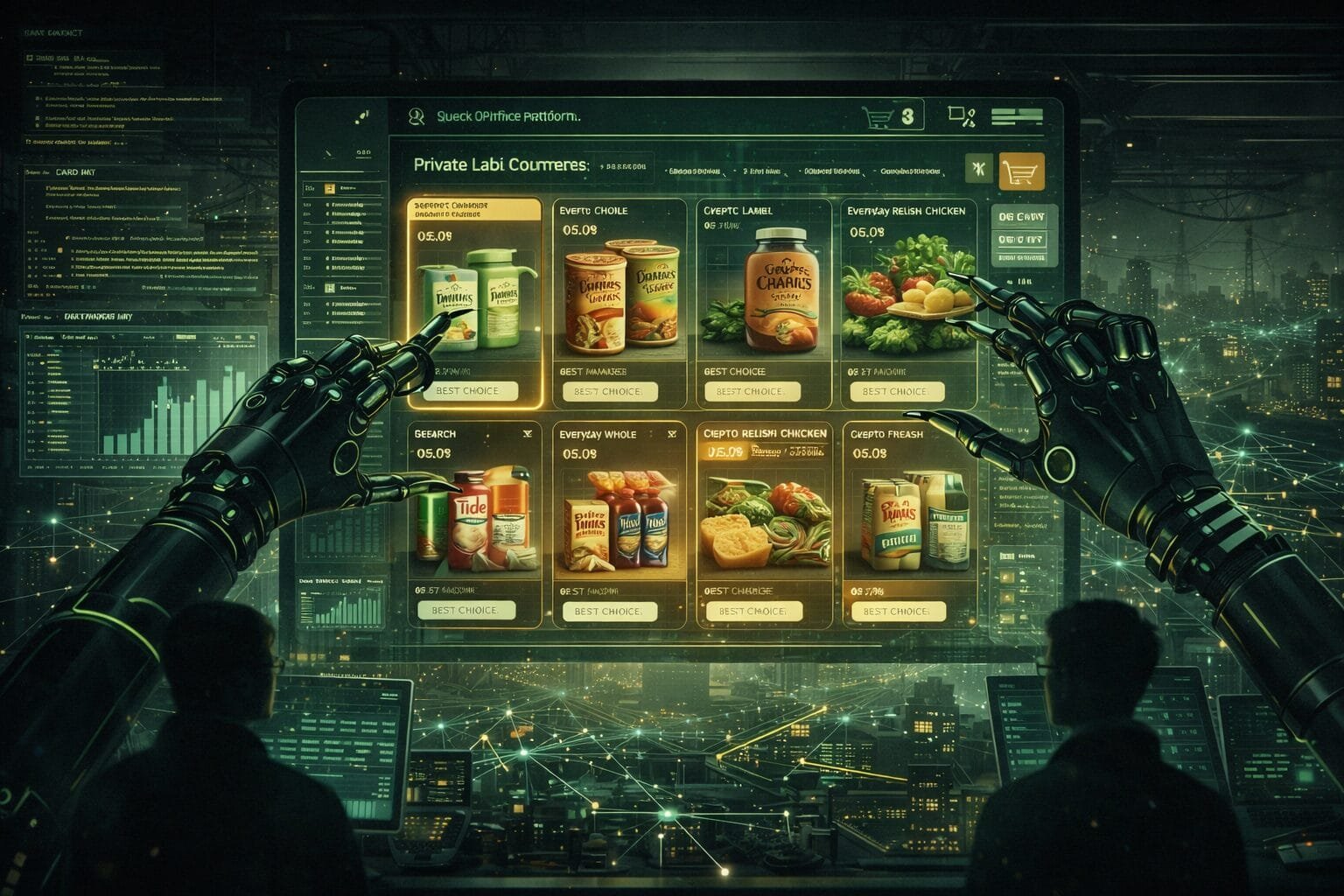
The Vertical Retail Pivot
Quick commerce is undergoing a fundamental economic realignment. As the industry advances through the 2026 fiscal year, the operating model has pivoted from delivery speed to inventory control. India’s sector leaders—Blinkit, Zepto, and Swiggy Instamart—are shedding their identities as pure logistics aggregators to emerge as high-margin vertical retailers.
- The Vertical Retail Pivot
- The Structural Shift: From Aggregator to Owner
- Signal vs Noise
- The Contrarian Thesis: The Ad-Revenue Cannibalization Paradox
- First-Principles Analysis: Flow-System Economics
- CXO Stakes: Capital Allocation & Systemic Risk
- Post-Mortem: The Autopsy of the “Pure Logistics” Failure
- Strategic Imperatives for 2026
The economic imperative driving this transition is stark: the legacy model, which relies heavily on third-party grocery margins of 15–25%, fundamentally fails to clear the fixed costs of urban dark store operations on any order below ₹750. By aggressively scaling private labels—specifically in high-velocity categories like perishables and staples—platforms are engineering a pathway to gross margins of 40–60%. This retail pivot is the primary mechanism for achieving a sustainable ROIIC (Return on Invested Incremental Capital), marking a maturation away from the purely growth-driven valuation models of early 2025.
The Structural Shift: From Aggregator to Owner
This strategic evolution is a direct response to a persistent “AOV Ceiling.” Despite high urban delivery density, the Average Order Value (AOV) has plateaued near ₹600. To bridge the gap to the ₹750 breakeven threshold, platforms are deploying algorithmic steering to prioritize their proprietary house brands over established FMCG products.
- Margin Expansion: Private labels in the “Staples” category yield 25–40% margins, while “Perishables” (such as Zepto’s Relish meat line) can command upwards of 50%, fundamentally altering the unit economics of a standard basket.
- Shelf-Space Monopoly: Within a 10-minute delivery interface, consumer interaction is largely confined to the first four to six search results. By owning the brand occupying these slots, the platform eliminates the distribution premium paid to national FMCG players and captures the full economic value of the digital shelf.
- Supply Chain Control: Platforms are integrating deeply into packaging and supply chain infrastructure to guarantee that house brands meet stringent 2026 shelf-life mandates while executing turnover rates up to three times higher than national competitors.
In the current landscape, the signal order has flipped. Strategic alignment is now a prerequisite for survival.
Signal vs Noise
| Feature | Industry Signal (Hype) | Execution Reality (Noise) |
|---|---|---|
| Unit Economics | “Path to profitability achieved via scale and density.” | Systemic profitability remains elusive without a minimum 15% private label penetration. |
| Consumer Loyalty | “Users are fiercely loyal to the 10-minute delivery promise.” | Users are loyal to the algorithm; 70% of conversions occur on the first three “Recommended” items. |
| D2C Synergy | “Q-Commerce serves as a vital launchpad for emerging D2C brands.” | The platform acts as a “Commoditization Trap,” ultimately pressuring D2C brands into white-label supplier roles. |
| Regulatory Status | “Agile tech platforms enabling local commerce.” | Mounting regulatory scrutiny views dark stores as inventory-based e-commerce, challenging existing 100% FDI compliance structures. |
The Contrarian Thesis: The Ad-Revenue Cannibalization Paradox
While scaling private labels expands gross margins, it introduces a complex strategic paradox. Over the last two years, platforms like Blinkit have engineered sophisticated retail media networks, extracting 4–5% pure-profit advertising revenue from national conglomerates like HUL, P&G, and Nestlé.

The contrarian risk is that as proprietary house brands increasingly dominate the user interface, national brands will inevitably reduce their retail media spend, correctly identifying the platform as a direct competitor rather than a neutral distribution channel. Industry data suggests a “tipping point”—estimated near 20% private label penetration—where the marginal gross profit gained from a house brand sale is directly offset by the forfeiture of 100%-margin advertising dollars. Navigating 2026 requires precise execution: balancing AI agent planning costs against the need to maintain an interface neutral enough to keep national brands aggressively bidding for search visibility.
First-Principles Analysis: Flow-System Economics
In traditional retail, inventory functions as a “stock.” In the 2026 quick commerce ecosystem, inventory operates strictly as a “flow.” The physics of this model are governed by two distinct imperatives:
1. The Density Imperative: An urban dark store in a Tier-1 Indian market must consistently clear 300–400 orders daily merely to amortize the heavy engineering and real estate bottlenecks inherent to localized logistics.
2. Inventory Velocity: Exorbitant storage costs per square foot in premium urban nodes mean any SKU sitting idle for more than seven days effectively destroys capital. Private labels grant platforms the unilateral ability to manipulate this velocity. If a batch of proprietary organic pulses nears its regulatory “30% shelf-life” limit (under FSSAI 2025 guidelines), the platform can algorithmically prioritize it at the top of a user’s search query, ensuring rapid liquidation without margin-crushing discounts.

CXO Stakes: Capital Allocation & Systemic Risk
For the C-suite, the transition into vertical retail represents a high-stakes recalibration of capital efficiency. Operational success is no longer judged by top-line GMV expansion, but rather by how well the platform passes the Reinvestment Test when allocating capital toward proprietary supply chains.
The overriding systemic threat is the “Reliance Factor.” As entities like JioMart and Reliance Jiffy operationalize their Infrastructure-as-a-Service networks, they possess the capacity to drastically undercut independent private-label margins by utilizing their vast, pre-existing physical retail footprints. Independent platforms face a binary choice: aggressively invest in hybrid “Manufacturing & E-Commerce” models to legally bypass FDI restrictions, or risk regulatory classification as non-compliant, inventory-led e-commerce entities.
Post-Mortem: The Autopsy of the “Pure Logistics” Failure
The recent consolidation and shuttering of several smaller, pure-play delivery startups provides a vital economic post-mortem. Their failure was not a symptom of softening consumer demand, but rather a collapse of structural economics.
Root Cause: Operators attempted to sustain hyper-local networks on a narrow “Logistics-Only” take rate (yielding roughly 5-7% after delivery expenses) while contending with escalating gig-worker acquisition costs and severe power grid bottlenecks required for maintaining cold storage infrastructure.
Strategic Takeaways:
- Control the Margin, Not Just the Fleet: If a platform does not capture the margin of the physical goods inside the parcel, the fixed costs of last-mile fulfillment will inevitably erode the balance sheet.
- Algorithmic Real Estate is the Sole Moat: Brand loyalty is highly elastic in high-frequency, low-friction digital environments. The only defensible moat is absolute control over the default search result.
- Mitigate Ad-Tech Dependency: Subsidizing core operations via competitor advertising budgets is a vulnerable strategy reliant on third-party capital that can vanish overnight.
Strategic Imperatives for 2026
1. Inventory Rebalancing: Leadership must aggressively engineer a minimum of 15% GMV contribution from private labels by Q4 2026, prioritizing “Staples” for volume velocity and “Perishables” for margin capture.
2. Tiered Ad-Tech Architecture: Deploy a partitioned visibility system. Permit national brands to bid for premium placement, while hardcoding a “Best Value” default for house brands to establish impenetrable price-perception among consumers.
3. Regulatory Shielding: Proactively transition the operational ownership of dark stores to third-party “Managed Marketplace” franchisees, mitigating the severe risk of reclassification under restrictive FDI laws targeting inventory-based e-commerce.
4. Targeted CapEx Amortization: Restrict capital deployment for automated micro-fulfillment centers (mFCs) strictly to hyper-dense zones exceeding 500 orders per day. This discipline ensures the amortization of high automation costs within an 18-month window.